Factorization
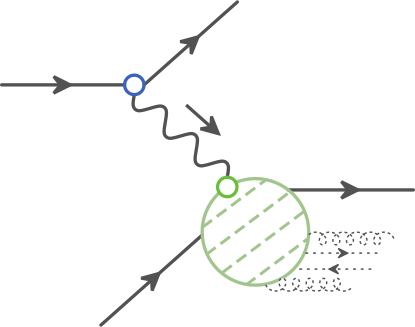
In blue the leptonic coupling, the corresponding green one, close to the blob, is instead the hadronic coupling. The blob itself is the hadronic contribution.
We refer to Factorization as the universal property that the DIS cross section can be factored into different parts: DIS Factorization ensures that the cross section can be split into a leptonic and an hadronic part. In addition on the hadronic part Collinear Factorization ensures that the structure functions can be split into an perturbative hard matix element and a non-perturbative PDF.
In the following we will explain how to connect the top-level observables and the low-level ingredients using the notation of [Z+20].
DIS Factorization
The fully inclusive DIS cross section \(\sigma\) is given by
where \(i \in \{\text{NC}, \text{CC}\}\) corresponds to the NC or CC processes, respectively. For NC processes, the summation is over \(b \in \{\gamma\gamma,\gamma Z,ZZ\}\), whereas for CC interactions there is only W exchange \(b=\{W\}\). The normalization factors \(\eta_b\) denote the ratios of the corresponding propagators and couplings to the photon propagator and coupling squared:
Implementation: propagator_factor()
The leptonic tensors \(L_b^{\mu\nu}\) can all be written in terms of the photonic lepton tensor, because the lepton is assumed massless:
with \(g_V^e = -\frac 1 2 + 2\sin^2(\theta_w)\) and \(g_A^e = -\frac 1 2\) the vectorial and axial-vectorial coupling between the Z boson and the lepton with charge \(e=\pm 1\) and helicity \(\lambda=\pm 1\).
For the unpolarized scattering, the hadronic tensor is given by:
Inserting the leptonic and the hadronic tensors into the cross section we obtain
where the \(-\) sign in front of \(F_3\) is taken for an incoming \(e^+\) or \(\bar \nu\) and the \(+\) sign for an incoming \(e^-\) or \(\nu\). The normalization factor \(\eta^i\) are given by \(\eta^{NC} = 1\) and \(\eta^{CC} = \kappa_W \eta_W\). So unlike in the NC process, in the CC process the leptonic couplings and the propagator corrections are not inside the structure functions but enter only on a cross section level. This is possible because in CC there are no interferences between different bosons. The structure functions are given by
Implementation: leptonic_coupling().
Similar decompositions holds also in the polarized DIS, where the hadronic tensor \(W_{\mu\nu}\) can be decomposed to other basic structure functions called \(g_4,g_L,g_1\).
Collinear Factorization
Using the collinear factorization theorem of DIS [CSS89] we can write any hadronic structure function \(F_k\) in terms of PDF \(f_j(\xi,\mu_F^2)\) and partonic structure functions \(\mathcal F_{j,k}(z, Q^2,\mu_F^2,\mu_R^2)\) using a convolution over the first argument:
where the sum runs over all contributing partons \(p\in\{g,q,\bar q\}\). In the following we will assume that a quark \(\hat q\) is hit by the boson. Note that this is independent of the incoming parton \(p\).
Using pQCD we expand the partonic structure functions in powers of the strong coupling \(a_s(\mu_R^2) = \frac{\alpha_s(\mu_R^2)}{4\pi}\):
Note that these two equations have to be checked for every reference as lots of different normalization are used in practice.
Similar to the splitting on the leptonic side we have to split on the partonic side again:
Implementation: partonic_coupling()
The dependence on the factorization scale \(\mu_F^2\) and renormalization scale \(\mu_R^2\) is discussed here.