DIS: process and definitions
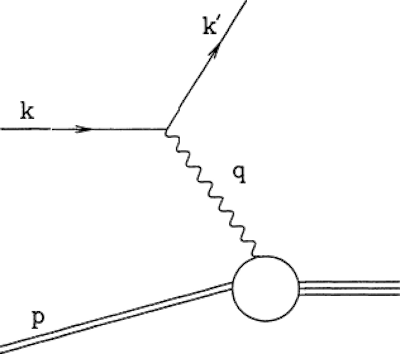
The Deep Inelastic Scattering process is the scattering of a lepton over an hadron component, mediated by an EW boson.
The leptonic part does not couple directly to QCD, thus the \(\alpha_s\) corrections do apply only to the hadronic side (at LO EW), and the EW boson can be seen as emitted from the incoming lepton and absorbed into the hadron.
In this picture the process can be interpreted as the scattering of an off-shell EW boson over an hadron, probing the hadron composition.
Kinematics
The following kinematic variables are often used in the following:
so \(M_h\) is the mass of the scattered hadron, while \(x\) and \(y\) are Bjorken variables.
Hadronic vs Partonic
Notice that the variables listed here are all hadronic, so \(x\) is not the partonic momentum fraction (it is only at LO, because the coefficient function is a \(\delta\)).
In order to avoid confusion the coefficient function variable will be called \(z\), and thus the partonic momentum fraction will be \(x/z\).
Notations
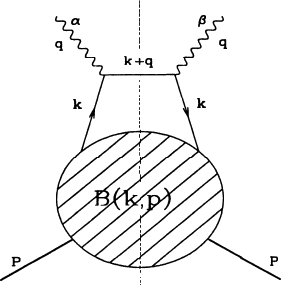
The handbag diagram (B(k,p) are the QCD corrections to the hadronic tensor)
We are following the notations in [Z+20], i.e. we’re using their normalization and definitions. So the hadronic tensor is given by
with \(\hat P_\mu = P_\mu - (P\cdot q / q^2) q_\mu\), \(P\) the 4-momentum of the hadron and \(q\) the 4-momentum of the scattered boson.
Process / Currents
yadism allows to compute three different type of processes, which correspond to a
given set of scattering bosons:
Electromagnetic Current (EM): we only allow the photon to be exchanged. This is the most basic setup and in many cases the only allowed option.
Neutral Current (NC): in addition to the photon we also allow for the \(Z\) boson to be exchanged, so this is a superset of EM. Since now two bosons are allowed also interference terms appear. The \(Z\) boson has an axial coupling to the leptons and thus it introduces the problems related to \(\gamma_5\) [G+17]. Note that there are no Flavor Changing Neutral Currents (FCNC) in the SM, but they are an active field of research.
Charged Current (CC): we only allow the \(W^+\) or \(W^-\) to be exchanged. The actual boson is determined by the incoming scattering lepton and charge conservation. As the \(W^\pm\) are flavor changing additional care is needed in the calculation.
Structure Function Kind
yadism allows to compute different structure functions, to which we refer to as kind.
In the unpolarized DIS we have:
while their counter parts for the polarized case are:
The reasons to chose such basis are:
the normalization is such that they have similar representation in the parton model. I.e. at LO they are all proportional to various combination of \(x f(x)\).
\[\begin{split}F_2 & \propto x \sum_q (q + \bar{q}) \\ x F_3 & \propto x \sum_q (q - \bar{q})\end{split}\]This normalization also follows the native scaling in the full cross section.
computing \(F_L\) instead of \(F_1\) is advantageous due to the Callan-Gross relation [CG69] \(F_L=0\) in the naive parton model
finally notice that the \(F_L\) definition it’s not exactly the one above, but it may be corrected (actually \(F_L\) it’s the object involved in Callan-Gross relation, for more information see F_L definition)
Note
\(2xF_1\) and \(2xg_5\) are also provided as they are treated as a derived quantity, like the cross sections in the following section.
Cross sections
yadism is also able to compute reduced cross-sections, that are observables
derived from the structure functions themselves.
The cross-section itself is only one, and the structure functions are simply its components resolved by kinematics, as written above in the hadronic tensor expression.
Instead the reduced cross-sections are many, distinguished by their
normalization, the following are available in yadism:
XSHERANCwhere:\[\begin{split}N &= 1 \\ y_+ &= 1 + (1-y)^2 \\ y_- &= 1 - (1-y)^2 \\ y_L &= y^2\end{split}\]and \(\ell\) is the kind of lepton: \(\ell = 0\) for the leptons and \(\ell = 1\) for the antileptons.
XSHERACCwhere:\[N = \frac{1}{4} y_+\]and the other variables as above.
XSCHORUSCCwhere:\[\begin{split}N &= \frac{G_F^2 M_h}{2\pi ( 1+ Q^2 / M_W^2 )^2} y_+\\ y_+ &= 1 + (1-y)^2 - 2 \frac{(x y M_h)^2}{Q^2}\end{split}\]and \(M_h\) is the mass of the scattered hadron, the other variables as above. This definition is consistent also with the
CDHSWexperiment. Note that a conversion factor from \(GeV^{-2} \to cm^2\) is required.XSNUTEVCC[O+06]:\[N = \frac{100}{2 ( 1+ Q^2 / M_W^2 )^2} y_+\]the other variables as
XSCHORUSCC.XSNUTEVNU[T+06]:\[N = \frac{G_F^2 M_h}{2 \pi } y_+\]the other variables as
XSCHORUSCC. Also in this case a conversion factor from \(GeV^{-2} \to cm^2\) is required.FWfrom theCDHSWexperiment [B+91]:\[\begin{split}N &= 1.0 \\ y_{-} &= 0 \\ y_{+} &= 1.0 \\ y_{L} &= \frac{y^2}{2 (y^2/2 + (1-y) - (M_{h} x y/ Q)^2)}\end{split}\]XSFPFCCfor the FPF projection:\[N = \frac{G_F^2}{8 \pi x ( 1 + Q^2 / M_W^2 )^2} y_+\]
Heavyness
All the observables are available in multiple heavynesses, that correspond to the inclusion or less of contributions related to heavy quarks:
totalis the heavyness that collects all the available contributions, according to the FNS chosen (see Flavor Number Schemes for details)lightobservables contains only contributions from light quarks, so no mass effects are accounted for (actually as the massive quarks were infinitely massive); in the ZM-VFNS it coincides withtotal<flavor>, e.g.charm, contains the contributions in which the heavy quark of selected flavor couples directly to the EW boson (as if only the charge of the given flavor is non-zero, while all the other couplings are set to zero)
Notice that the contributions in which the heavy quark is present, but does not
couple to the EW boson, are not included nor in light neither in
<flavor>, but they are of course present in total, thus:
All the heavynesses are defined tuning parameters at Lagrangian level, thus all the observables are potential physical observables, since they are well-defined and free of divergences.
For a more in-depth discussion with the relation of heavyness and FNS see Flavor Number Schemes.